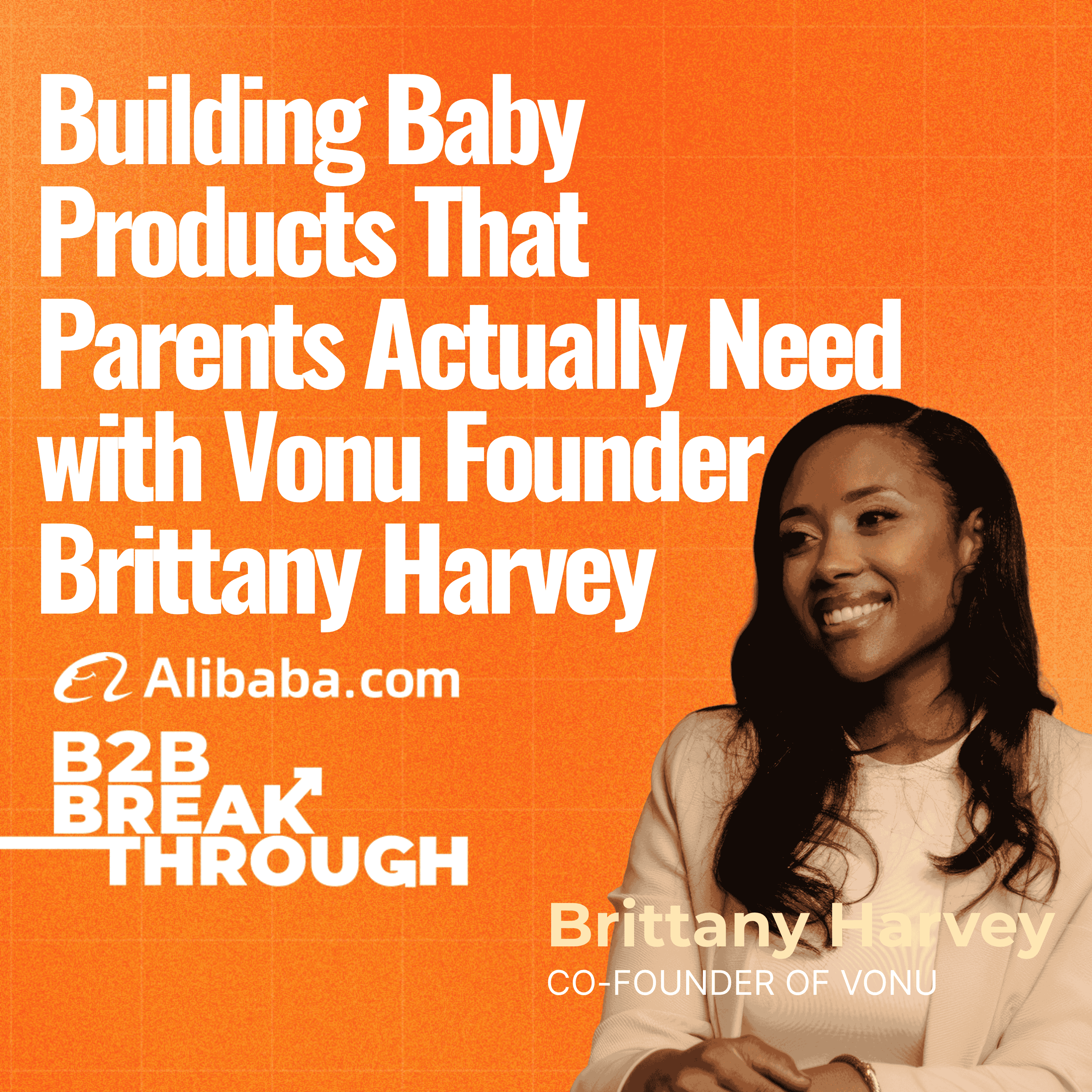
[00:00:00] Speaker A: If you're a parent, you've probably had a moment where you thought, this product would make my life so much easier, but it just never makes it out of the metaphorical group chat. Well, Brittany Harvey didn't let her idea stop there. She turned her There has to be a better way moment into the Berkeley lounger. And now she's doing it again with a stack pack, a modular parent design system that reinvents how baby gear works. In this episode, Brittany shares what happens when creativity meets necessity.
[00:00:24] Speaker B: Welcome to the B2B Breakthrough Podcast.
[00:00:27] Speaker A: I'm your host, Sierra Christo.
Brittany, welcome to the show.
[00:00:32] Speaker C: Show. Thank you so much for having me.
[00:00:34] Speaker A: We're really excited to chat with you today. I know having a baby and having a business is, you know, in the same universe. You know, your business is your baby and there's a lot going on in your life. Tell us a little bit about where you're at right now.
[00:00:46] Speaker C: Yeah. So business wise, Vanu is starting our third year of business officially, which the time has flown. There's three co founders of VanU, my husband is one of them, and together we have a nearly three year old daughter and we are 30 weeks pregnant. And so there is a lot happening in business and personal. It almost feels like we have a set of twins between the first child in the business as well as a little baby on the way. So we're doing all the things all the time.
[00:01:20] Speaker A: That's entrepreneur life, that's founder life. That's incredible that you're juggling all of those pieces.
[00:01:26] Speaker C: Absolutely.
[00:01:27] Speaker A: So I mean, as a parent founder, what inspired the Burpli? And what is the Burpli? Let's set that foundation first.
[00:01:35] Speaker C: Yeah. So the Burpli is a patented memory foam lounger that can be used for babies from 0 to 9 months. And it was initially created out of our own struggle with our daughter. When we brought her home from the hospital, we didn't have any family nearby. So we were essentially like taking on that first experience solo. D'oh. And it came with a lot of lessons really fast.
There was one night where it was like 2am and she had really bad gas and discomfort, which led to her not being able to sleep. And so she was screaming and crying in pain and like online on Amazon, trying to get the quickest thing to us to help relieve her discomfort. And everything we found was either medicinal or just like physically invasive. And we weren't really interested in either.
And so we started propping her up ourselves, doing a lot of upright positioning in between feedings, even when she was sleep. Sometimes we'd just lose sleep kind of holding her up to ease that pain and try to help, like, the gas dissipate. And so eventually, like, probably a couple weeks into that, we were barely surviving and we started thinking about, like, why doesn't something exist that can just prop them up and just so you can at least, like, be next to them, be in the same space as them, and not have, like, the physical strain of that in addition to, like, nursing or, you know, holding them most of the day anyway. And so we invented the Burpley. We initially were making it. We made it like the first prototype with just like, memory foam mattress toppers. And we kind of. I got like a turkey carving knife, the electric ones that he used at Thanksgiving. And I was just like, over our dining room table, like, trying to shape this memory foam to, like, the image I saw in my mind.
And we just like, glued it all together, the layers. And then we had a local seamstress create a cover for us. And I know, like, in hindsight she probably thought we were so crazy. Like, what is this?
Like, you have no specs, you have no measurements. Like, we just handed her the lounger of memory foam, like, glued together, and she created the COVID And that was the first prototype. And from that point forward, it took us about 90 days before we ran our first production of Burpley's. And then I would say I think we ordered about 300 in that first order. And before we even got the 300, they were sold out on our website.
Yeah. So that was how everything kind of got started. And it's been a roller coaster since then.
[00:04:26] Speaker A: What a crazy beginning. It's so, so quick, so impactful, so hands on. Were you, you know, you mentioned you sold it on your website. Were you supported by Kickstarter or anything to get this message out? How did you find your. Your audience that quickly? Organically.
[00:04:45] Speaker C: So at the time. And anyone who's been postpartum can probably, like, millennial and forward can probably attest to you actually use social media more when you're postpartum just because your baby's so little and you're keeping such crazy hours. Like, at 2am I would be scrolling. I did a lot of, like, tiktoking when I first had my daughter just because it was like, honestly, a little bit isolating. Like, you're in this bubble of maternity leave. You' in the real world, your day to day is completely focused on this tiny human you're trying to keep alive and make sure you're Doing everything right and learn them while you're learning yourself. And so I was using TikTok for, you know, entertainment interaction as well as a search engine. So a lot of my questions as a new mom or, like, what products? What schedule? What are you doing for nursing? Like, all of these things. I was researching on TikTok a lot, and so my algorithm was feeding me a lot of mom content by that point. And a good part of it when dealing with my daughter's, like, gas pains and reflux was that a lot of moms were so frustrated and then in turn, like, saddened by not being able to help their little one. I came across one mom who was just sobbing on TikTok. She was like, I don't know who else to go to. Like, I've been to the doctor. I've done this. I've done that, like, listing all of her things, and she's just like, I'm so exhausted, because, you know, if they're not comfortable, they're not going to sleep. And she was like, I can't rest. I can't. Like, she's not eating well. Like, all of the things, right? Because it creates this cascade of events. So initially, we just put it out there on TikTok and Instagram, and we created kind of this video. Like, we documented the process of obviously having our daughter. Like, our whole phone is filled with videos of her and then along the way creating Berkeley.
And we didn't know at the time that it would be what it was. But once, you know, we were ready to launch the website, we created this founder video where it was just me talking over pictures and videos I had of what led us to do this, like, why it meant something to me and how it's helped our daughter. And that video went viral organically.
And so with that, that was where we, like, found our initial base of customers. And, like, I wish I could show you our original website, because looking back, it makes me cringe, but at the thought it was so great and so cute. And, I mean, people loved it. People did love it, and so I guess that's all that matters in hindsight. But, yeah, we just sold out pretty quickly. People were looking for a solution, and I think we just stood in that gap. And that was the realization, like, that I was like, okay, like, we can really keep doing something here, because it was a gap for us. And we were like, why doesn't this already exist? There has to be more. Like, we're gonna find more things that should already exist along the way in this parenting journey. And so that was how we got our start organically.
[00:07:55] Speaker A: Well, I mean, it sounds like there's nothing else on the market remotely like this. So what alternatives you mentioned you were trying as everything you could before you decided to take that turkey knife to a block of memory foam.
So what other alternatives were you exploring and just finding that they fell short initially.
[00:08:15] Speaker C: They offer gas drops, which, like, if you're doing your baby registry, every, like, mom or like, pediatrician is going to tell you, like, oh, make sure you have gas drops. Make sure you have gas drops on hand. Because, like, when the gas hits and they can't, it's basically like their nervous system isn't ready to like, burp on their own or pass gas on their own. So you have to aid them in that process initially, otherwise the air gets trapped. So there were physical products, like I said, it was the gas jobs. Then second would have been something that was like, in my opinion, a little invasive at that time of something that you kind of like inserted inside of them and then it released the gas.
And then the third thing was like, there's another product. I won't say it's similar to ours because it wasn't created for gas reflux or tummy time relief, because it wasn't designed for that. It actually wasn't like, ergonomically sound, especially for a baby's, like, spine and neck. And so there just wasn't anything available.
[00:09:19] Speaker A: So, yeah. I want to talk a little bit about the early phases of design.
How has the structure of the burpli changed over the years? Are there a lot of differences or did lightning strike on the first. On the first pass?
[00:09:33] Speaker C: So to be honest, structurally, there aren't a lot of differences. We have come out with the Berkeley Pro or Berkeley 2.0, which is more recent, and structurally it's similar in terms of the 40 degree angle and the indents and all of the ergonomic support. But the look is very different. We came out with like more of a sleek, compact design and we were just. We just took feedback from parents as well as our own evolution as a company. And so we put out the first Berkeley just with the emphasis on. On like the actual functional design of it. And then as the company has evolved, as our branding evolved, all of these things, the Berkeley Pro is really just a more sleeker, more modern design.
Our initial design, it has the same level of support, same functionality and purpose. But the new one, as our company evolved, as our branding evolved, all of these identities that we carried with us and saw also what our consumer base was interested in.
We just came out with a sleeker, more modern and compact design. It's a little smaller than the original Berkeley.
[00:10:42] Speaker A: Very cool. So it sounds like you had to do a lot of research. I think parenthood in general is trial by fire.
Every baby's different. You learn about anatomy along the way. You learn about so much just organically. What kind of research went into figuring out that 40 degree angle, understanding what was going to be most supportive for your baby's spine and best for digestion? How did that research come about?
[00:11:11] Speaker C: I think it just took a little bit of critical thinking from us outside of this just being working for our own child. So we did some measurements and some calculations on the angle that the average parent's shoulder is, which is the position you normally put a baby to burp in.
Um, or you're holding them up and they do the little spit up over your shoulder on the burp cloth. So that angle as well as like people who would burp their baby over their knee. And we kind of combined like that research with our own lived experience as well as information that we learned online from like chiropractors, occupational therapists, holistic approaches as far as like the stretches and the movements and the angles to best try to relieve gas or extend that like digestive tract, give them space to like, for their body to kind of push the gas either up or down to get out. And we kind of combined all those things and luckily it, it made sense, it was functional. And then later we were able to consult with like pediatric therapists and occupational therapists and all of that and found out that they not only did they approve of the product, but they were using similar but more basic devices in their own practice, especially occupational therapists for babies who have other challenges or things that they need help with for tummy time, as well as different things like NICU babies, babies with G tubes, just different challenges, babies with down syndrome that we didn't even consider initially that fall into this category that are Berkeley is helping.
[00:12:53] Speaker A: How has that market expanded? That's an interesting point. I didn't think about how.
I think a lot of products come with this one specific purpose in mind. How do I help my child in this situation? But that's really incredible that it's also impacting these other communities.
How has that outreach and expansion gone for you on social media or interacting with parents? How was that feedback then?
[00:13:18] Speaker C: For me, it's been super touching and important. I still run customer service, getting those DMs and things that we really didn't plan for or consider initially completely just altered, like our brain chemistry in terms of what was possible for Berkeley.
And, you know, we would get messages from nurses in the NICU like, hey, I have a baby who's, you know, in my care who was on a G tube. And I recommended their parent order this, but because it's helped a lot with them doing tummy time, they weren't there. They struggle with ways to do tummy time with babies who have G tubes because that medical apparatus is like in their stomach area.
And so being on it directly on it isn't always an option as well as like, just preemie babies. I remember in the early days I got a DM from a mom who was like, my baby isn't even. Wasn't even supposed to be born yet. And they're like starting to hold up their neck because they're on their burpley doing tummy time. So of course, like, I shed mom tears like all the time when I get these messages because I just feel like it's so cool. And, you know, I thought I was doing one thing to help one group of people, but to see that it's so expansive, it shows me just how much it was needed, that it's helping parents and little ones, like, across the board, regardless of their challenges or if they're considered like the average child without any challenges, all of those things.
[00:14:47] Speaker A: Well, it's also so validating and encouraging for parents struggling with these issues to see that you trust it with your own child, you created it for your own child. And, you know, if the creator was willing to put their baby on this, you know, it's supportive and helpful and safe. And if nurses and healthcare workers are recommending it, what if, bringing endorsement, how did that impact you? When you hear that nurses in the NICU are making this recommendation, it really.
[00:15:13] Speaker C: Made things feel official. And I mean, still to this day, right, like, we get fatigued because we look at our website like 50 times a day, we look at our Instagram account 50 times a day, and it's just like, okay, yeah, but this could be better, or, like, this could be worked on, or what are we doing here? This doesn't look good here. And then when you randomly, like, run into someone and they ask you what you do and you like, give them your website or, you know, somebody reaches out to you or whatever the case is, it's just like another validation, right? Like, almost three years in, we've done, you know, over $2 million in revenue. And I still like, am so happy and relieved to get those moments of like, validation. Like, no, this is real. This is like, you have a real business. Like, this is really working. Like, people think this is cool.
[00:16:04] Speaker A: It's incredible. I'm not, I'm neither a parent nor an entrepreneur, but having that moment of realizing that it's has a broader impact. It's really incredible.
[00:16:13] Speaker C: Yeah, yeah, it's. And we find it with. So we have like the stack pack, which is available on pre sale now. But even when I was at Co Create, I was carrying around the stack pack and a flight attendant stopped me and he was like, do you guys like make these for flight attendants? I was like, well, we make them for parents, but anyone can buy them. And he just like started breaking down, like walking me through how great, how perfect this bag is for flight attendants. And I was just like, I literally never thought about that. He was like, I'm telling you, like, you'll do great if you market to flight attendants. I was like, I don't know how we're going to do that in the same place, but yeah.
[00:16:57] Speaker A: That'S the influencer market. You just got to get him on board and you're going to take off.
So how did you decide to expand to the stack pack? On top of the Berkeley, you already have a child, you've got your business life's overwhelming. That's a big undertaking to create an entirely separate product. What told you that this is worth it?
[00:17:20] Speaker C: I feel like my greatest source of inspiration is just my experience every day. So that was like the next thing that was really eating at me. And I'm a Virgo, I'm a bit of a type A personality. And so I put together a very extensive baby registry before our daughter was born and did a lot of research and. And there weren't that many diaper bag options in the first place, which I was genuinely shocked by.
And so I started looking and I decided on a diaper bag and it was like $200.
And I was like, wow. Like, that's, you know, an investment as far as I'm concerned. But you know, we want multiple children. I'll keep the diaper bag, so on and so forth, justifying this purchase. And it seemed to be the best one available to me. And so once I got it, I loaded it up, you know, before we even had her. And I'm like, okay, pacifiers in here, diapers here, change of clothes, like all the things that like, before you actually have the kid, you like, think that, okay, this is perfect. This is Neat. I have everything I need. And I remember one of the first times going out with her by myself.
And no one really prepares you for that first outing in the real world. If you're like, just, you know, just one parent with the baby and you're thinking of all the little things that they might need and you get them all, like, in the stroller or the car seat, and then you have to take them out and change them again and are they too warm? And just all of these things, it becomes, you know, like a bit overwhelming, overstimulating pretty quickly. And then you realize, like, oh, the one thing I need is in the bottom of this, like, black hole that I cannot find in the seconds I need it to, like, reach back while I'm driving to give her a pacifier, whatever the case is. And at that moment I was just like, this makes no sense. This is another thing that makes no sense.
And so I was really inspired or found it fascinating again on TikTok, like, previously, the bento style of organization, which is like a Japanese style of organization for lunchboxes, are carrying food, like, somewhere. And it's kind of stackable. It's modular compartments. And I just thought it was really neat at the time. And I didn't think I would ever apply it to anything other than, you know, my own lunchbox once I got back into the workforce and stuff.
And so when I was thinking about, like, why don't they make this better, I was like, why don't they just make a diaper bag that's this bento style, stackable, kind of modular situation?
And so I drew it up. I'm. I'm not like an artist by any means, but I was able to draw to the point that a designer that we had worked with previously got what I was saying and kind of worked with him a couple back and forth so that he could sketch it up and get, you know, the real design going that I was looking for. And once I saw it, I was like, yep, that's it. Like, people who buy this, I know it.
Yeah, it's fun to realize, like, something you created is really cool. Like, you really find it useful. And then you realize, like, it has your logo on it, like it's your product, it's your baby again.
[00:20:47] Speaker A: It's one of those expansive applications where people are seeing these other uses, other audiences that you can expand into.
How has that, that pre sale, pre order process been going? Can you share a little bit about that?
[00:21:01] Speaker C: Yeah. So to be honest, we haven't pushed it. Like, we haven't read ran any meta ads on the stock pack just because we were ironing out logistics. We have it on our socials and on our website. We've gotten organic sales just from that as well as like emails. So that lifetime value of reaching back out to people who purchased the Berkeley, who, you know, now might be looking for a diaper bag that has converted well for us. So we're really excited for when we do an actual push for that to see how it converts. And so, yeah, we're, we're not doing, we're going to run ads, but we're hoping to use it more as like a lifetime value prop in our business and I think it'll go really well. You know, like, if you're in the, I guess, market for Berkeley, you're most likely going to be in the market for a diaper bag. And I love that our stack pack is perfect for people who have one child, more than one child.
And it just, it's so customizable. So I think people will find the wide range of like, application very helpful for them, especially compared to what's on the market.
[00:22:09] Speaker A: For sure, for sure. And as your family expands, you're going to see the, the added use cases and the benefit of dealing with multiple kids and, and packing for them. Who knows where Vanu's going from there. There could be more.
[00:22:23] Speaker C: Exactly, yeah. I mean, we're always like in an R said all of our founders, all three of us hold patents across different industries. And so it's kind of just at the core of, you know, who we are. As Vanu is innovation, we can be having a conversation about meta ads and A3PL and then it can quickly turn into like, hey, do you know what I was thinking of the other day? Wouldn't it like be cool if. Or wouldn't it make sense if. And we'll kind of get running and so we have multiple, multiple things in R and D now and we're hoping to really become a staple of the baby community.
[00:23:01] Speaker A: Totally. Well, I mean, with, with innovation as the central pillar, this ethos, you know, you've really cultivated a space where it welcomes new ideas. How do you nurture that, that culture within your, your group, within your, among your co founders? Can you tell, tell me a little bit about those conversations?
[00:23:23] Speaker C: Yeah, so we have the three co founders and then we have a small team of contracted workers, which is a, kind of capitulates anywhere from like 6 to 10 people at a time.
And we just don't think that we're the Only one with ideas. Basically, like, we're willing to talk to other people, we're willing to hear feedback. Early on, we started VIP groups for our customers that would like personally email or DM us or people who left reviews and we would invite them. Even people who didn't leave good reviews, we would invite them into these VIP groups on Facebook and Instagram and ask, you know, take polls, ask for feedback, keep up with just conversation. Like I would ask to see their kids Halloween costumes, like if it was Halloween time. And we would just have this like genuine back and forth with our customer base, which was, you know, much smaller at the time. But even still, where, even when we rolled out new covers for the original Berkeley, we were doing polls to see like, what patterns are you guys interested in? Like, or if we do a holiday collection, like, are you guys into this or that? And just getting feedback on what people wanted to spend their money on or what they needed to spend their money on. And from there, you know, we constantly get ideas. There are some times where people have really great feedback and they're like, oh, have you thought of this or would you use it for this? And we're like, oh yeah, I mean that makes sense. Yeah, that's not our personal situation. So it didn't come to mind. But thanks for sharing. And that's another way we can, if it's not changing the product, even market the product so that it is reaching people who can really take advantage of the existing design or functionality.
[00:25:08] Speaker A: Yeah, that's great. Having that, that close connection with your audience will always yield positive results.
And the more you know your base, the better you'll be able to cater to them.
[00:25:19] Speaker B: Is the complexity of sourcing holding you back? Are you getting overwhelmed by information in an endless search now? Sourcing for your business has never been easier. Meet Axio, the world's first AI sourcing engine that helps you source like a pro. With five key features, you'll get product inspiration that leverages real time market data from comprehensive web insights, social media trends and B2B knowledge. Generate detailed requirements to find the perfect match from AI verified products and suppliers through Axio's multimodal search. Use supercomparison to easily discover and compare millions of products from leading suppliers, focusing on the best selling and most competitive options. With Axio Page, you'll get AI generated encyclopedia pages that compile verified product information for each sku. And finally leverage Axiom Axio Agent to streamline negotiations with conversation, guidance, real time summaries and direct answers about products and suppliers without Having to browse detail pages. Head over to Axio AI today. That's Accio AI to try Axio for free and start sourcing like a pro.
[00:26:24] Speaker A: You mentioned earlier when you were first ideating around the Berkeley, you, you had all this time postpartum to scroll through TikTok and see what other moms were struggling with. Now you've got a three year old, you've got a business that's doing very well.
I imagine you don't have the same time you did in those early weeks to really dig into the scene.
How are you staying connected with the conversation on socials?
[00:26:52] Speaker C: So I definitely don't have as much time. So I try to make the time that I am scrolling meaningful. So I'm constantly kind of like spending scrubbing my algorithm to do away with kind of the noise or things that are just entertainment for me and then focusing more on the business which isn't always as fun. Like sometimes, you know, I want a good like reality TV show clip on my timeline that I'm no longer getting much of anymore. But it's okay, I think, you know, everything comes in seasons and so right now I just try to make my time more valuable when I am doing market research or having those interactions. I also have more time to talk to moms in person now because my daughter's like of a socialization age. She's wanting to go to the park, she's wanting to go to the library. So I'm interacting with moms more in person than I was in those first few weeks or months with a newborn when there's not much to do besides watch them sleep and feed them.
And so I'm getting, I'm getting a lot of, you know, feedback and things like that and then also signing up for other businesses emails, purposefully liking their ads so that I get fed more and see what their funnels are like from like a business approach. Just purposefully inserting myself in a lot of funnels for brands that I like or you know, really don't like. But I might see them doing something cool or, or something that we can learn from. And so my inbox is pretty overwhelming if I don't like clear my email every day. My personal email is like off the charts because I'm getting so many, I'm in so many funnels but it's super helpful and it's research. So yeah, just trying to make that time more valuable that I do have because I don't have a ton of it. It's funny because when you have the first kid and you're like in those trenches. It feels like it's so heavy and so tough. And don't get me wrong, it is because it's the first time. But like this second pregnancy, having a three year old to chase around, I'm like, oh my God, that first one was a breeze. Like I was taking naps, I was like kicking my feet up and now I was like literally telling my husband last night I was like, I'm not like exercising as much as I did the first pregnancy, but I would say I'm more active because like, if I count my steps, I feel like I'm getting in more steps. Just chasing around our daughter or like bending down, constantly picking up her toys or playing with her, it's just, it's a totally different ball game.
[00:29:33] Speaker A: Oh, I believe it. I believe it. Seeing, you know, I'm in the same season of my life where I'm seeing my friends have babies and I'm seeing how much they're chasing their kids around and it's, it's exhausting. It's a lot, but it's non stop. There's no break.
But I love what you said about how now you're interacting with moms in person more. It's like you're able to put your lifestyle to work for you as you're ideating. So your market research is shifting formats. I think that's so.
It's so natural, so intuitive, but it's also very intentional. But you're able to engage in a different way because you're not having the same scrolling time. So finding these alternate routes is.
[00:30:23] Speaker C: That's very cool.
[00:30:25] Speaker A: How have those conversations influenced the conversations that you're having behind closed doors with your co founders?
[00:30:31] Speaker C: Yeah, I would say so. I'm the, I'm the only mom co founder. The other two are dads. So it's a totally different vibe, let me tell you.
So there are times where I'm just like, we'll be reviewing something with our team, whether it's an ad or copy for an email and I'm just like, it's not going to work. Like, that's not going to work.
We're not putting that out because I know that's not going to work. And they're like, what do you mean? And I'm just like, I can't fully tell you but like, I'm a mom and I know other moms and that's just not what we're attracted to. That's not what we're interested in.
That's not our pain point. Like all of these things. And so I think getting more of that real life conversation and real time responses to like, other products that are being put out or what's needed as things are evolving, it gives me a lot more leverage in those conversations internally. Because one thing, and you know, I heard this, I think it was on a podcast, honestly, but a mom was just like, one thing moms do is they talk to other moms. Like, you'll be in the park, you'll talk, you'll be on a mom form, you'll talk, you'll be in the comments of something and you'll talk.
They were like, dads don't really talk to each other that much. And I was like, yeah, I was like, I think you're kind of right, though. Like, I'm thinking like when I see a dad at the park versus moms, I. I kind of see them off to the side. And I mean, not, you know, they're different creatures, of course, but like they're just kind of with the kid or off to the side watching the kid. And the moms kind of try to find community, which I think that's like what women traditionally do in, you know, in the human species, period, is build community. A mom's experience is completely different than a dad's. Not that a dad's is any less, it's just totally different. And then also the dads, like our third co founder, becoming a dad recently has reminded us of so many aspects of the newborn phase that we're no longer in. As the other two partners that he's like, reminding of us of. Like the, the joys, the inconveniences, the needs, like all of these things happening that because, you know, it's a fog the first time you do it, and it happens fast but slow at the same time. You know, things we didn't necessarily take note on expecting to start a full baby company at the time, we've been reminded of those things. So it's, you know, we both have completely different vantage points as fathers, as mothers, um, and then even the other people in our communities, the other caretakers, grandparents and siblings and aunts and uncles and all of these things. I'm sure as we have our second child and we see the dynamic between siblings and, you know, ideas will spark there about different things to, to help with that acclimation process of, you know, becoming a parent of two or three or four, whatever what that looks like.
[00:33:33] Speaker A: That's such an interesting perspective that moms are talking, but dads aren't at the. At the park, at the playground. You know, it reminds me of an article that I read years ago that talked about how women socialize face to face and men socialize side to side. They watch sports, they play sports, they play video games, and that's how they connect with one another as friends.
Yeah, there's. There's an activity that's grounding them in the interaction, but women are bonding and connecting. And so I'm curious, you know, as you founded this business together, is that inspiring the men in your life to connect more and to provide some insights from a dad perspective for these products?
[00:34:17] Speaker C: In my personal life, I would say the men in my personal life are extremely involved in parenting. And I don't know if it's like a generational thing or the fact that I'm surrounded by people who have the flexibility in terms of entrepreneurship. So I think that changes can change family dynamics more as well. But I'm thankfully in a space where a lot of the men are super involved and there's not much like, primary caretaker dynamic, which, you know, isn't a problem. If that works for your family, I think that's great. And I understand people have nine to fives. People have real world responsibilities that have to be taken care of and, and can be on somebody else's timeline or schedule. And so I absolutely respect that. You know, that's totally fine. But I've had the opportunity to watch, you know, my husband step in all the time, the whole time. And so I'm really thankful for that. But I do.
I don't know that dads are shifting as a collective. I think maybe society is calling them to. And I think that. I feel like this would be a great question for a dad. Right. Because I think that their algorithms, their what they're subscribing to all of these things. Things are shifting. And I would be interested to know how it's getting fed to them or what their thoughts on it are. But we definitely have dads all the time that are ordering, that are emailing, that are leaving comments. And so I would say, though our primary market is our moms, I think we just haven't taken the time to focus on marketing to dads. Like, we have some ads running currently that are targeting dads, and they're doing extremely well. And it's something that we didn't prioritize initially. Yeah, just thinking like, you know, moms are the purchasers, Moms are the purchasers. But what we've also realized in this amount of time is how Much dads are the supporters of the moms. And so if the mom is in this postpartum era and complaining about something or stressed about something, your partner is the first person who's going to want to help fix that or find a solution for that. And so we're finding that marketing to dads as well is just as effective, because though they might not be the ones doing the suffering, they're the ones who are charged with the solution. And so there you are.
[00:36:44] Speaker A: That's an interesting insight. I love that. Well, I mean, let's use this opportunity then, men. Tell us what you think, tell us what you need, or, Yeah, tell us about your struggles. We need to know what's the dad perspective?
[00:37:02] Speaker C: Yeah, we won't. This isn't something that gets asked often, so please take advantage. We want to hear your complaints.
[00:37:08] Speaker A: Speak up, man. Let's.
[00:37:09] Speaker C: Let's hear it.
[00:37:11] Speaker A: Yeah, so, like, we'll expand on that and learn a lot more about how dads are. Are interacting with the space. But as you were talking about developing these products to. To find solutions and suit these needs, I want to talk to you a little bit more about the manufacturing process. And I'm working backwards a little bit, but we talked about how you handmade and worked with a local seamstress to create your initial prototype. How did that develop? How did that shift and change as you found manufacturers?
[00:37:40] Speaker C: Yeah, so that definitely was not going to work for mass production.
So at that point, we kind of got, I believe the title was like, a design engineer, and they did, like, the final specs based on, like, rendering and I don't know exactly all of the language, but they did. They took my drawing, they took my prototype and made it something that could be shared with manufacturers in, like, a tech pack format and so that we could start shopping around for manufacturers. So at that point, we were pretty careful with the shopping around just because we didn't want to put our idea out there to just anyone across the world who had the capabilities. We thought of creating it, and they would basically just have like, oh, here you go, here.
And so we actually ended up getting a sourcing agent. And so with that extra layer of trust, with that being our first time and this also being a custom product.
And so we have the sourcing agent, and she was able to narrow down to a couple factories for us and tour them with us like on FaceTime or on Google Meet, and we were able to talk to the factory owners and kind of walk through what we wanted the relationship to look like, what would work on both ends, timelines, their capacity. And for us, what was really important in the beginning was having someone we could trust, they felt like they could trust us, would have good MOQs, would have good turnaround time, would be able to handle the process of forwarding the goods for us, and then also wasn't a huge factory, like, would value our business from the beginning, but also have the capacity to grow with us as our demand group needed. And so with all of those factors, we landed on the manufacturer that we still have today.
And they've been able to thankfully, like, grow with us, give us, like, some great lead times in terms of, you know, when you ship from across the world, it can take 30 to 45 days to hit the West coast of the US and then, you know, take another two to three weeks to, depending on where your 3 PL or your warehouse is, like, get, get to that point. And so those are all things we have to consider with our cash flow being bootstrapped.
And so the manufacturing process for us is a big part of our operations and logistics in terms of, like, timing everything with cash flow, timing everything for the customers, maintaining that relationship. If there are any hiccups with either of those aspects, kind of figuring out how we're going to work through that with obviously somewhat of a language barrier, cultural barrier, and also factoring in, like, their holidays and when they won't, like their factory is shut down or, you know, what's going on in the world politically, economically, what that looks like. Like I said with the tariffs recently, like, sometimes things were on a standstill, like, can we afford this amount in shipping at this point? Do they need to hold goods for, you know, and just having that bond or that trust that we built over the two years before those things started to arise was super helpful in navigating, like, the past six months of, you know, some turbulence or things that were a bit unexpected.
[00:41:10] Speaker A: There's so much that you have to factor into creating a product, especially when you're initially launching. So to have that trusted support, to figure out how to triage your time and to really evaluate your options, that's huge. Are you using or did your sourcing agent use alibaba.com@all in the process?
[00:41:30] Speaker C: So we have our main manufacturer for Berkeley, but we also have other accessories on the website that build our bundles.
And we definitely used Alibaba to build out some of the accessories for our bundles. And so that was a pretty seamless process. My husband has used Alibaba in the past plenty of times with other, like, entrepreneurial ventures and efforts. And so we're very familiar with the platform at the time. And it's a really seamless process. Like, we had multiple manufacturers we reached out to that had what we were looking for, and we were able to, like, kind of hop on a call with them, like, hey, is. Is this something you'd be able to do? What's your turnaround time? All of these things. And it's been a really seamless process. And the manufacturers that we work with for those accessories for our bundles are super pivotal because our bundles help to increase our average order value, which is a big deal for our company. And so if we run into a snag with those bundles, like having the inventory for that, that's a really big deal for our business. Like, it can be the difference between, you know, a profitable day and a day in the.
And so we take those relationships very seriously, and we stay on top of it. And even if, you know, we have lulls in ordering because, you know, we'll order a large quantity, get it, and, you know, we're moving. And like I said, we're a bootstrapped business, so it's not always a continual order. But we'll keep up with those relationships and just check in, like, hey, in the next 90 days, we're looking to place an order like this. Like, are you guys still on the same page? Like, do you have the capacity with the holidays coming up, like, all of those things are happening in real time now? Yeah, but we haven't had any issues. It's been a great experience, as always. Like, we weren't surprised by that, and it was like the first thought to go to, so it's been good. So how do you.
[00:43:25] Speaker A: How do you factor in what. What is a valuable accessory to go with. With the burpley and with the stack pack?
How does that vetting process work for you?
[00:43:35] Speaker C: So for us, it's kind of just what makes sense with it. So if you're in the business of tummy, like in the market for tummy time, you're in the market for engagement cards. If you're interested in tummy time, most likely you understand or we can easily educate you on the importance of tummy time and how it's kind of the foundation for a lot of other developmental milestones, including crawling and walking. And so with that being said, there are things that, you know, you might want for crawling, like the knee pads so your kid's not rubbing their knees across the floor all day long, or the grippy socks so they can stand up without sliding all over like wood floors. So really it's just finding what complements that, that kind of thought process and time and space that the parent is in. Anyway, when they order their burpley, we also have our gas bundles. So if you're not ordering for tummy time's sake, that's just an added bonus. You're ordering because your little one has gas and reflux.
We sell our burp booster, which helps put a little bit more pressure on their diaphragm to help with like stubborn gas. And then our warming pad, which is a really cool warming pad. It's like a heating pad if you know and. But this one is made out of flaxseed and it can just be reused, like reheated over and over and you just wrap it around their belly and it helps like ease the gas and reflux. And it's just like a little baby spa day kind of thing.
But it does like functionally help in soothe them. And so building out those bundles with the accessories really just. It's one of those things that you put yourself in the parents shoes and you imagine what else are they adding to their cart if they're on Amazon where you can get anything and you're not just like sequestered to this product or this business's website and then basically build out their cart for them, like have what's available on Amazon on your website all together for a bundle.
[00:45:36] Speaker A: Well, it's also great when you put yourself in a gifting mindset. When you're thinking about a baby shower. You never, you know, it's always nice to add a little, a little plus up with a gift. And so that's, it's a really intentional process. So I think that's, that's a beautiful addition to the, the product line. That's awesome.
[00:45:54] Speaker C: Yeah. Yeah.
[00:45:55] Speaker A: Did you ever think that you would know this much about gas?
[00:45:58] Speaker C: And honestly, no, because I didn't even think about gas before I had, before we had our daughter, I never even thought about gas. And I certainly didn't think of like pain being associated or sleep deprivation. Like the way like how quickly they go from it just being like a small, like, oh, I have gas, I guess a baby to like, oh, now this whole house is not getting any sleep and I'm also not going to eat. Like it escalates quickly.
[00:46:29] Speaker A: The ripple effect.
The ripple effect is so bad.
That's hysterical. I think that's.
I love this model. I love this mindset of just thinking intuitively about what your child needs and how you've built this huge system around you to bring this product to market. So where are you selling now? What are your main sales channels?
[00:46:52] Speaker C: Yeah, so our main sales channel is our website and then we sell on TikTok shop and we sell in the UK, we sell in Canada through our website.
So that's taking a lot of bandwidth right now, like that international expansion. Just because it's taken us three years to get the US based to what it is and to think about reapplying that somewhere else is. It's a lot. It's a big undertaking.
Yeah.
[00:47:22] Speaker A: Yeah, no kidding. Well, and. But now you're. You're working with a 3 PL, you mentioned. How is that that helped your personal bandwidth as a co founder?
[00:47:30] Speaker C: Yeah, so that's a very young relationship for us. Our first three PL experience, I think was a little rushed and didn't turn out great to the point where we ended up sending trucks to go get our inventory from their warehouse and driving it all the way to Charlotte and bringing it back to us so that we could take over fulfillment. Like for us, the customer service and fulfillment is such a big part of the business. Like if your customers are unhappy, it doesn't matter if they. If they need your product and you can't get it to them or you aren't getting it to them in a timely manner, it doesn't really matter how much they need it because you're not actually like providing a solution for their need. And so we experienced that for a few weeks and it was just like a really tough situation and we had to make a tough call to just in the relationship. Relationship. And so I would definitely encourage anyone to do a lot of research on your three pl, make sure, you know, the legal contractual part of that situation is beneficial or makes sense for your business if you do need to pull out of it, because things can change really quickly with your business. And three PL services is one of those things that can make or break you if you're starting out and you're not getting, you know, the results that you were looking for that you were giving yourself. And so this next three pl, I had a little ptsd. So it took us a long time to get a new 3PL. And so that looked like me fulfilling all of the orders as well as my husband, like fulfilling orders for the past few years every day on top of the actual work of the company, which fulfillment is a large undertaking as well, inventory management, all of that. And so we had a warehouse here for a while and then thankfully we have A large garage. And I can't tell you how many times we've had. Well, one time we literally had an 18 wheeler semi in our residential neighborhood at 2am dropping off 11 pallets of inventory for me and my husband to unload in the middle of the night while our daughter was inside sleeping. And that was just like a logistical error on everyone's part. We thought they were coming at 2pm it turned out to be 2am we thought they had a lift gate. They did not. Like, so many things happened and we learned so much and it only costs us one full night of sleep.
[00:49:56] Speaker A: But you know, in the scheme of things, that could be so much worse.
[00:50:02] Speaker C: I was just like, at least we have the space. At least like we can physically move. So we did that. We. I'm saying that to say we've done it all in terms of like fulfillment in our own hands. And so now we have this new relationship and so far it's been really great. I'm really thankful it's freed up our bandwidth extensively. Fingers crossed it continues to go like this.
Yeah, we can keep expanding, you know, our reach with our capabilities and bandwidth each day now that we've given up fulfillment. I'm really excited to see what it looks like about Around Black Friday, Cyber Monday, because we traditionally are not able to travel. Like, people say they want a business and I'm like, but are you willing to like not go anywhere for the holidays or when people come to you? Like for the past two years I've had like my grandma, my mom fulfilling orders like on Christmas in my garage because it's like, you know, we're getting hundreds of orders. This stuff has to go out as soon as the post office is open back up again. And so like, it's a real family affair of like doing orders and stuff. So I'm really thankful for those memories. But I'm also thankful that I'll be able to go to my family for these, you know, the upcoming holidays and not worry about people getting their orders from my hand.
[00:51:22] Speaker A: It's a great Christmas Day activity. I love that.
I'm so happy for you that, that this three pl is, is off to a better start than the first one. Sending you good vibes, all the good energy.
So I want to kind of wrap us up here. Thinking back, you know, to those early days, what do you wish you knew at the very beginning that would have set you, that would have given you some peace of mind?
[00:51:46] Speaker C: Now the most important thing you can do is pay attention to your business.
And I guess What I mean by that is, like, there's so much noise about E commerce and business online, on X, on threads, on people's podcast, clips everywhere, right? You're getting this overflow of information, and it can become paralyzing very quickly, or it could put you in a situation where you're applying what they apply to their business, to your business, and there's really no place for it. It makes no sense. And so I think the more time you spend with your business, the more time you spend with your metrics, your operations, your spreadsheets, truly understanding the ins and outs of your customer base and your different audience avatars, the more that you'll be in a position to decipher what information is relevant and actually build out, you know, like these systems or these plans, or take in what's going to work for you versus what's not. Like, kind of clear the noise. And I think in the beginning, especially with E. Com, because you don't have a brick and mortar space, you're just online all the time.
And, you know, we're in a digital age where you can get access to anything, any amount of information, any type of information, anyone's opinion.
And I think it can send you on this, like, really crazy path initially.
And it's not super helpful. It kind of wastes your time in a lot of ways. And so learning how to, like, decipher and filter and kind of wade through those waters, I think is super important. And the other thing I wish I would have known is just like. Or wish I would have applied is the concept that the time will pass. Like, do the work, because the time's going to pass. Even when it's hard or when you feel like you're not making headway, you look up. And whether, whether you accomplish the thing or not, the time passed. So just keep working, keep learning and getting things done, because you can look up and you can have made progress. Even if you haven't reached your goal or you can look up, you're in the same spot where you were wishing that you would have started two years ago.
[00:54:04] Speaker A: Yeah, I love that. I love that little steps all lead in the same direction so, you know, better off, you know, putting in the work. And if you don't see an immediate return, it'll get there.
[00:54:16] Speaker C: Patience. Yeah, definitely. Yeah, it's like the overnight success concept. Like, people, you know, feel like maybe like certain things are an overnight success, when in reality it's like I was working on something else for ten, you know, almost ten years before this. All the things I learned from that is what helped make this an overnight success.
Totally.
[00:54:37] Speaker A: That's, that's such an important insight. All, you know, a lifetime of experiences goes into having that epiphany and going out with a cool product and you, you know, you're, you're kind of spoiled. You had a 90 day kickoff like, you know, that overnight success, spoiled in.
[00:54:53] Speaker C: Some ways and dragged through the mud in others.
[00:54:57] Speaker A: So that's fair. I don't want to paint too rosy a picture, but, you know, you know, it's a very, it's a very fortunate start and I think I'm, I'm so. That's incredible. Kudos to you.
[00:55:08] Speaker C: Thank you so much. Thank you.
[00:55:11] Speaker A: So before, before we sign off, can you tell folks where to find you on your socials, on your website?
[00:55:16] Speaker C: For socials, for Instagram, we are vanu official.
V o N U official.
And then our website is vanubaby.com and so those are the best places to find us. If you need to reach me directly, you can feel free to email
[email protected] or even hit our support.
Awesome.
[00:55:38] Speaker A: We have all the resources. That's so cool. All right, well, thank you so much, Brittany. This was an awesome conversation and I hope, I think this will help other entrepreneurs and moms.
[00:55:47] Speaker C: I hope so. Thank you for taking, taking the time with us. Yeah.
[00:55:50] Speaker A: Thank you.
[00:55:51] Speaker B: B2B Breakthrough is produced by Alibaba.com to find out how Alibaba.com is empowering its.
[00:55:57] Speaker A: Customers with the tools, services and resources.
[00:55:59] Speaker B: They need to grow their business. Visit Alibaba.com and then make sure to search for B2B Breakthrough on Spotify, Apple Podcasts, or wherever you find your podcasts. Make sure to follow us so you don't miss future episodes. On behalf of the team
[email protected], thanks for listening.